
Why Thinking Your Way Out of Anxiety Doesn't Always Work - And What to Do Instead

young person under the covers, peeking out.
You're lying awake at 2am, running the same thought on a loop. You know, logically, that catastrophising won't help. You've told yourself to stop worrying. You've listed the reasons why you should stop worrying. And yet here you are, still awake, still spinning.
It feels like a thinking problem, but it isn't. Not entirely.
Anxiety isn't just a cognitive experience, it's a visceral body based experience. And you can't think your way out of a state your nervous system drove you into. Understanding why that is, and what to do about it, is one of the most genuinely useful things you can take out of a therapy room and into your everyday life.
Two kinds of anxiety - and why the difference matters
Not all anxiety is the same, and the distinction matters when you're choosing what to do with it.
To understand why, it helps to know something about how the body actually processes our experiences. We tend to talk about "the nervous system" as a single thing, but it's more accurately a network of eight interconnected systems, all in constant conversation. Each plays a role. None operates in isolation.
Key Divisions and Functional Subdivisions
Central Nervous System: Consists of the brain and spinal cord, acting as the main command center. The eyes are the only external part of this system, and play an important role.
Peripheral Nervous System: Comprises all nerves outside the brain and spinal cord, linking them to limbs and organs.
Somatic Nervous System: Controls voluntary movements of skeletal muscles.
Autonomic Nervous System: Controls involuntary functions (heart rate, digestion).
Sympathetic Nervous System: Mobilises the body for action, stress, or "fight-or-flight" responses.
Parasympathetic Nervous System: Relaxes the body, responsible for "rest-and-digest" functions.
Enteric Nervous System: A complex network regulating the gastrointestinal tract.
Sensory System (or Afferent Division): A subset of the PNS that transmits sensory information to the CNS.
What this means in practice is that your body is processing information on multiple channels simultaneously, most of them outside of conscious awareness. Long before you've formed a thought about something, your body has already begun responding to it.
At the centre of this network is something sometimes called a gating system - a filtering mechanism that takes incoming information and makes a rapid assessment: safe or unsafe? Known or unknown? Act or stand down? Think of it less like a bouncer checking IDs and more like an air traffic controller managing dozens of incoming signals at once, routing each one to the right place based on accumulated knowledge about what's dangerous and what isn't.
It's extraordinarily sophisticated. It can distinguish between a loud noise that's a threat and a loud noise that's just a truck going past. It can read a room, sense a shift in someone's tone, notice that something feels off, and it can do all of this faster than conscious thought.
But when trauma has occurred, the calibration shifts. The gating system becomes more sensitive, its threshold is lower, its filters are wider. The gates start letting through signals that resemble the original threat, even when the actual danger is no longer present. A tone of voice, a smell, a particular quality of light, the way someone stands in a doorway. These things pass through the gate not because they are dangerous but because they share enough features with something that once was really big. The body isn't being irrational. It's applying the most important lesson it ever learned, as broadly and as quickly as possible, because that's what kept you safe, and in some cases, alive.
This is where the two kinds of anxiety diverge.
Everyday anxiety is the nervous system doing its job accurately: flagging a possible threat, running the risk assessment, keeping you alert. The thinking brain is still online. You're worried, but you can still reason. In this state, cognitive tools work well because the gating system is still open to new information, you can update it with evidence, reframe the thought, talk yourself through it.
Trauma-based anxiety is different. Here, the threat response is already firing before the thinking brain gets a chance to weigh in. The gate has opened without filtering out past v present, and the alarm is sounding, and no amount of reasoning will close it from the top (thoughts) down. The body has to be met where it is first. In this state, trying to reason with yourself is a bit like trying to have a calm conversation in the middle of a fire alarm. The alarm has to come down before anything else is possible.
A useful concept here is the window of tolerance. Inside it, you're activated but manageable, anxious but still able to think and function. Outside it, the nervous system has taken over and the thinking brain is largely offline. The tools that work inside the window are different from the ones that work outside it. Both matter. Neither is better. And most people, at different points in their lives, need both.
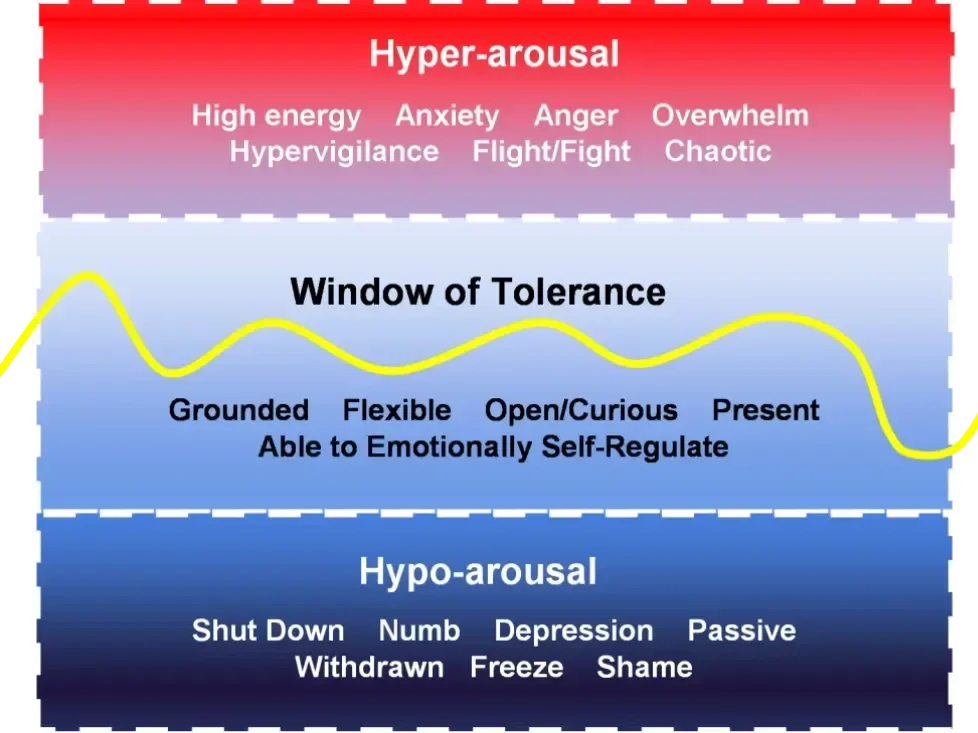
Window of tolerance diagram.
Top-down tools: working from the mind
These work best when you're inside your window of tolerance, anxious, but still able to think clearly.
Cognitive reframing
This is the practice of noticing the story your brain is telling and gently examining whether it's accurate. Not replacing it with forced positivity; that rarely works and can actually get in the way of genuine wellbeing, but asking honest questions. Is this thought a fact or an interpretation? What's the evidence? What would I say to someone I love who was thinking this? We can do this in therapy in a number of ways for example using Narrative Therapy to rewrite the stories, Acceptance and Commitment Therapy to de-fuse the fused (sticky) thoughts that keep coming back, and more.
The goal isn't to feel better immediately. It's to loosen the grip of a thought that feels more certain than it actually is.
Thought records and journalling
When anxiety lives only inside your head, it loops. Externalising it, writing it down, changes the relationship with it. You move from living inside the thought to looking at it.
A simple starting point: divide a page into three columns. The thought. The evidence that supports it. The evidence that doesn't. You're not trying to win an argument with yourself. You're just getting the full picture on paper rather than running it on repeat in your head.
Affirmations
Affirmations often get dismissed as wishful thinking, but the neuroscience is more interesting than that. Repeating a positive, present-tense statement with intention releases dopamine and, over time, supports serotonin regulation - gradually building new neural pathways through repetition and consistency. The negativity bias means your brain has had a lot more practice running the other kind of thought. Affirmations are a way of evening that out, slowly. (For a deeper look at how this works, the happy chemicals article and resource are a good place to start.)
ACT de-fusion
This is one of the most practically useful tools from Acceptance and Commitment Therapy, and it works on a simple but powerful idea: you are not your thoughts. You are the one observing them.
When you're fused with an anxious thought, you're not ‘having’ it, you are it. It's like being attached to a boulder rolling downhill. Pushing back, arguing with it, or forcing positivity over the top of it just puts you in its path. The boulder wins every time.
Defusion doesn't stop the boulder. It unhooks you from it so you can watch it roll past.
A simple defusion practice to try: add "I notice I'm having the thought that..." to the front of whatever the anxious thought is. eg. "I notice I'm having the thought that I'm going to fail." "I notice my mind is thinking that something bad is going to happen." That small shift in language creates just enough distance to change the fusion. You're no longer the thought. You're the one noticing it.
Bottom-up tools: working from the body
These are the tools you reach for when the nervous system is already activated and the thinking brain is largely offline. Trying to use cognitive tools here is like trying to read in a moving car, technically possible, practically very difficult. Start with the body first.
Breathwork
The breath is the one part of the autonomic nervous system you can control consciously, which makes it one of the most direct routes to calming a threat response.
The key is the exhale. An extended exhale - longer than the inhale - activates the parasympathetic nervous system, the body's rest and recovery state. A simple starting point: inhale for four counts, exhale for six to eight. You don't need an app or a guided session. You just need to breathe out for longer than you breathe in, and give it a few minutes to work.
Movement
The stress response was designed for physical action - fight or flight. When neither happens and the activation has nowhere to go, it stays in the body. Movement helps complete the cycle.
This doesn't have to be a gym session. A walk around the block, shaking out your hands and arms, even standing up and moving between rooms - anything that gives the nervous system's built-up energy somewhere to go. The research on this is consistent: movement is one of the most effective bottom-up regulators available, and it requires no equipment and no expertise. Notice animals like dogs and horses when they do the full body shake/shiver, same thing!
Expressive arts
Not everyone can access words when they're anxious, and that's normal, the pre-frontal cortex is being bypassed in favour of survival. Expressive arts - drawing, colour, music, movement, all offer a way to externalise what the nervous system is holding before language is available. The process matters more than the product. This isn't about making something beautiful. It's about giving form to something internal so it has somewhere to go other than back inside you. Scribble in a notebook is fine!
Bilateral stimulation
The brain naturally processes experience through a rhythmic, side-to-side patterns, left/right, up/down - something you can observe in REM sleep, where the eyes move laterally as the brain files the day's experiences. Bilateral stimulation replicates this rhythm consciously: tapping alternately on your knees, crossing your arms and tapping your shoulders, walking, or using alternating sounds through headphones.
For everyday use, simple bilateral tapping can support the nervous system to settle and process rather than loop. In a therapy context, this is developed much further - Brainspotting, for example, works with fixed eye positions to access and process material stored below conscious awareness. This is work done with a therapist, not alone, but understanding that the brain has this capacity is genuinely reassuring. Processing isn't something you have to force. Given the right conditions, it happens naturally.
Parts work (IFS)
Internal Family Systems therapy offers a reframe that many people find immediately useful: the anxious part of you isn't all of you, and it isn't the enemy.
In IFS, anxiety is understood as a protective part doing its best to keep you safe - often working from old information, old threats, old rules about what the world is like. When you fight anxiety, you're fighting a part of yourself that is trying to help. When you get curious about it instead, what is this part afraid of, what does it need, when did it learn this, the relationship with it changes.
A starting point: next time anxiety shows up, try asking it a question rather than arguing with it. "What are you trying to protect me from?" Notice the part of you that is communicating, even if just the knot in your belly. You don't have to like the answer. You just have to be willing to hear it.
This is work that goes much deeper in therapy, but even the orientation shift, from fighting anxiety to getting curious about it, is something you can begin on your own. No Bad Parts is a useful book by the founder of IFS Dr Dick Schwartz, and if you get the audio book he guides you through meeting your parts and working with them.
It's not either/or - it's sequencing
Top-down and bottom-up tools aren't competing approaches. They work best together, and the sequence matters.
Regulate first, then reflect. Body, then mind. When the nervous system is activated, start with breathwork, movement, or bilateral tapping to bring yourself back inside your window of tolerance. Once you're there, the cognitive tools become available again - reframing, journalling, defusion.
A simple decision point: can you think clearly right now? If yes, start top-down. If no, start bottom-up. Neither is a failure. They're just different entry points into the same process.
A final note
Understanding your anxiety doesn't make it disappear. But it does mean you stop spending energy fighting yourself and start working with what's actually happening. The nervous system isn't broken when it's anxious. It's doing exactly what it was built to do. The work is in learning to recognise what it needs, and having enough tools to meet it there.
If this is resonating at a level that goes beyond what a blog post can reach, this is exactly the work we do at SJP Wellbeing.
[Book an Initial Consultation.]
(And if you haven't read the companion piece on your happy chemicals and the negativity bias, that's a good place to go next. It fills in some of the neurological background that sits underneath everything covered here.)