
Talk Therapy and Somatic Therapy: Why the Lift Has to Go Both Ways
Somatic therapy is having a moment. Vagus nerve resets, nervous system regulation and body-based healing are all over social media (and honestly, some of it is great to see).
I too work somatically. As a trauma therapist, body-based approaches are a big part of how I practise, and I’m a huge fan.
But I’m noticing a trend. These approaches are being talked about so much it’s becoming pop psychology, the latest magic fix for trauma and all ills. And in some spaces talk therapy is being written off as the old way, or the less effective option.
That worries me, especially as I’m hearing feedback from clients about other therapists and have clients coming in with pre-existing ideas of what they want, how they want to work - which on the one hand is excellent, yay for buy-in, yay for psycho-education, yay for approaches being empowering and accessible for people! But on the other hand, there are sometimes variables they don’t know to consider. It isn’t one or the other. It never was.
Top-down and bottom-up
In therapy spaces, we often talk about top-down and bottom-up approaches.
Top-down approaches start with the thinking mind. Noticing thoughts, challenging fixed thinking, reframing, understanding patterns.
Bottom-up approaches lead with the body and the nervous system. Sensation, felt sense, regulation, movement, expression.
Both matter. And the most effective therapy usually moves between them, integrating cognitive components and autonomic body reactions.
The working lift
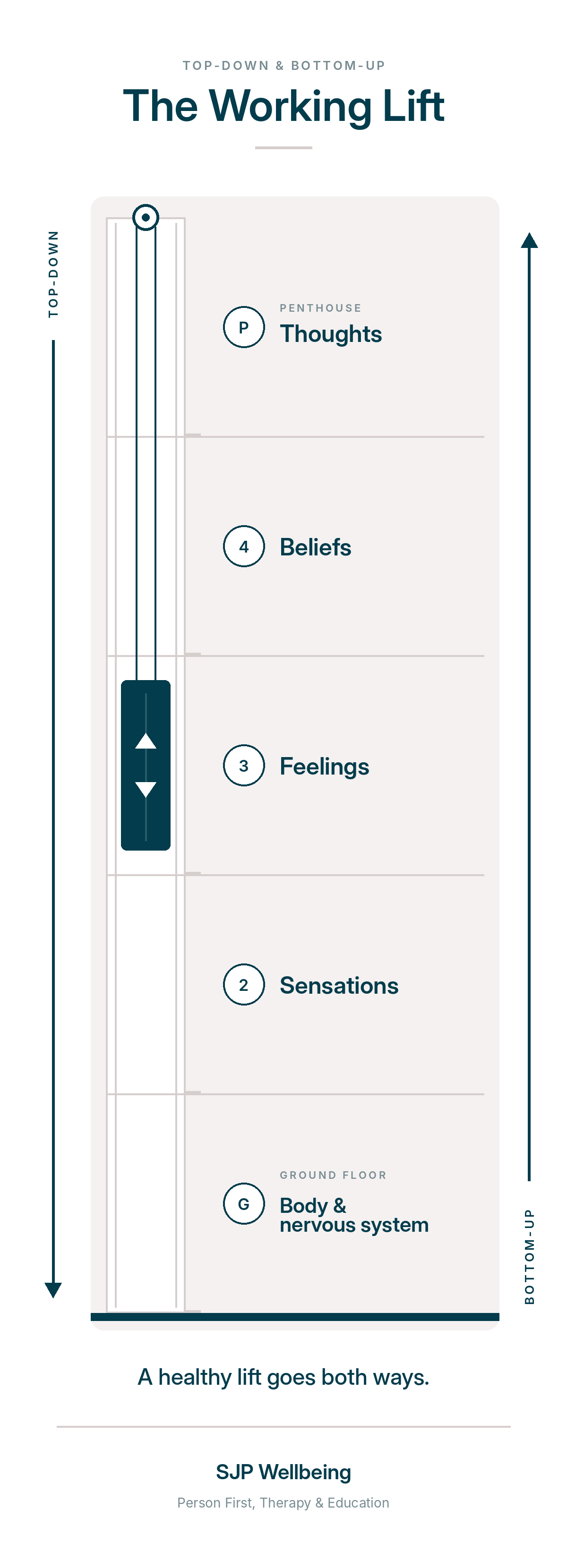
I like to think of it as a lift. The analogy comes from Janis Briedis, a UK-based psychologist and schema therapy trainer, who uses it in his Body-Focused Schema Therapy work.
Up in the penthouse sits the cognitive mind. Being able to talk yourself out of fixed thinking or catch an automatic negative thought is an incredible skill. It’s really important.
But if that’s the only floor the lift ever visits, it isn’t a working lift. It’s a stuck lift.
We also need to go down. Down into feelings, beliefs, sensation, the nervous system and the body, and all the information held there. Some of what we carry was laid down before we had words for it, and the body is often where we find it. To process an experience, we need to be able to actually experience it.
A healthy lift goes both ways. And it takes time to get it moving.
Some people live more at the top
Some people are drawn to highly cognitive (talking) therapy. They may see themselves as logical. They may say they’re not overly emotional, or can’t access them.
That’s not entirely true, everybody experiences feelings, things are always happening in our bodies, in the felt sense. Bodies are noisy, but psychologically we can have mechanisms that inhibit the interpretation. So Its a little bit true, in their experience of themselves.
Part of the work is understanding why. For some people it’s how their brain is naturally wired, including many neurodivergent people. For others it’s alexithymia, where naming and recognising feelings is genuinely hard. For many it’s an adaptation. Growing up where feelings weren’t safe, weren’t welcome or weren’t noticed teaches a nervous system to stay upstairs. At the risk of upsetting some people, historically most men would be in this camp. Overtly and otherwise told that men don’t have emotions, while simultaneously throwing a shovel, or punching a hole in the wall. To be clear, this is not me demonising men, I think they have been harmed by this framing.
Other people live at the opposite end. Health anxiety is a good example. Someone may spend too much time in their sensory experience, then analyse every sensation, and get caught in a loop between both floors.
When mindset isn’t enough
Plenty of people know all the right things to say. They think positively. They reframe negative thinking. They still feel like rubbish.
They still feel inadequate, ashamed, anxious or like a failure. Often because those feelings are normal human responses to what has happened, or is happening to them.
Mindset-only approaches and toxic positivity can teach us that normal human experience is abnormal. You can’t gaslight yourself out of what you actually feel. In a lot of cases, people get worse.
I’ll own this next bit, come at me if you must. There are life coaches and wellness voices working well outside their scope and training (if they have any past their own experience). I used to coach, and I stayed evidence-based and in my lane. Many don’t, and people get hurt.
In defence of supportive counselling
I hear professionals dismiss what’s known as supportive therapy. I strongly disagree. I mean, think about the opposite of that?
Think about someone who has spent a lifetime being silenced. Belittled. Afraid to speak truthfully, speak up or set a boundary.
Practising those things with another human, in a safe, supportive relationship, is the work. At least in part. Ranking one way of working above another is unethical and harmful. Our job is to meet people where they’re at, not to be fixed on how WE like to work. If you are seeing a therapist who is pushing one way of working on you, you should take that as a red flag (imo) - I don’t mean to say they have to expert in every modality or area of practice, I mean to say they are pushing you to work in the way that THEY feel most comfortable, instead of referring you on, or adjusting things to your current needs.
For example, I’m not a huge Cognitive Behavioural Therapy proponent. That doesn’t mean CBT doesn’t work. Good approaches overlap. They have different names and different entry points, and often do something very similar in effect. So I would explain that, and endeavour to find the helpful parts of that modality to bridge that need. We would explore together the ways we can work on cognitions and behaviour change.
Stabilisation, processing and readiness
In trauma therapy there’s a long-running debate about stabilisation versus processing.
Stabilisation means building safety and capacity before processing trauma: resourcing, skill building, psychoeducation, understanding your inner world, building trust in the therapeutic relationship and widening support, both internal (self) and external (networks).
Processing is the part people often picture when they think of trauma therapy. It means revisiting a memory, or the feelings and body responses attached to it, while staying anchored in the present.
The science behind this is called memory reconsolidation. When a memory is activated, it becomes changeable for a short window of time. If the brain receives new information during that window (for example, I’m safe now, it wasn’t my fault, I survived), the memory can be stored again with that update. The memory stays. The charge it carries shifts.
Many approaches are thought to work this way, including EMDR, Brainspotting, Internal Family Systems, Schema Therapy, and somatic therapies. They have different entry points and a similar effect (when done well and safely).
Reconsolidation asks two things of a person at once. The memory needs to be felt enough to activate, and the present needs to feel safe enough to hold it. Both of those take readiness and capacity.
Older models suggested up to a year of stabilisation for complex trauma. Newer research, particularly in EMDR, argues stabilisation isn’t always necessary, and that processing itself is the fastest route to stability.
I don’t believe stabilisation is outdated. But even if it were, people arrive at therapy with very different levels of stability already in place. One person’s readiness for EMDR is not another person’s.
This is why clients sometimes ask, “Why haven’t we done any processing yet? It’s been six sessions.” A friend may have done EMDR early with great results. That’s real. It just isn’t everyone’s path. Nor should it be.
What readiness looks like for different people
For someone with complex trauma, the body may hold genuine danger. Protective strategies keep them out of it, and they’ve worked for a long time. Pushing past them too early can overwhelm rather than heal.
For someone living with borderline personality disorder, or extreme emotional dysregulation, feelings can arrive like a flood. Talk-based skills work, such as building distress tolerance, naming emotions and repairing in relationship, such as in therapy with a skilled relational therapist, is often what makes deeper work possible at all.
For neurodivergent people, and people with alexithymia, body-based prompts like “What do you notice in your body?” can feel confusing, unreachable or distressing. Interoception works differently. Cognitive and relational entry points may be the doorway in.
People with chronic health conditions or chronic pain may find the body a hard place to be. Turning towards it is not neutral.
And then there’s emotional neglect. It’s one of the hardest things to treat, and the story people often carry is “nothing happened to me.” By and large, that is their experience. An experience of nothing. No connection, no co-regulation, no support. It’s not that they didn’t have big feelings, it’s that even as a child, they were faced alone.
They often cope through numbing, avoidance or disconnection. They may look highly functional in some ways, oftentimes quite flat in affect. They often come in for depression, not trauma. And under stress they go flatter.
How do you process something in the body when the person can’t yet feel it? For them, stabilisation is learning to feel. Letting sadness and grief in. That can take years, and it has to happen organically before we press the processing buttons.
Not a magic tool
Somatic therapy is powerful. It’s also not a magic tool. Vagus nerve resets are just that, a momentary shift and down-regulation. Relief matters, down-regulation helps, the brain-body connection is HUGE, But…
Talk therapy is not second best. Skills, talking, understanding, psychoanalysis, psychoeducation, mapping, schema work and a trusting therapeutic relationship are a core part of the work, including inside something like EMDR and other trauma modalities.
The goal is a working lift. Up and down, as often as you need, at a pace your nervous system can handle.
That’s what Person First means to me. We start with you, not the modality.